
Ethics
Ethics is the basis of ENGIE’s corporate culture. We adopt a policy of zero tolerance to corruption. We take action against any evidence of corruption, bribery, or inappropriate conduct. See the four principles underlying our policies, practices and which contribute to the Company having a more ethical and sustainable environment.
Principles and commitments
In unison with its values and commitments, ENGIE seeks to operate in all environments according to the laws and regulations existing in the countries where it conducts its business.
In order to protect our values and commitments, the Group has implemented several policies related to the ethics theme in order to sustain strategic decisions, management, and professional practices in the daily routine of all Group employees. Compliance includes all the procedures and policies which we implement to protect and promote our principles.
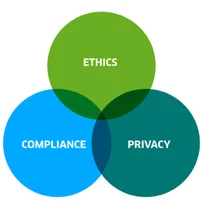
For us, ethics is an essential part of our strategy, management style and individual professional practices. Ethics helps drive performance.
Our ethical principles
To be an engine of performance and a reflection of the Company’s values, ENGIE has ethics at the core of its strategy, management, and practices.
ENGIE’s Code of Ethics is based on four cardinal principles:
- 1 - To act in accordance with the laws and regulations
- In all circumstances, Group employees and entities must respect international, federal, national, and local legislation as well as the rules of corporate ethics relative to their activities.
- 2 - To behave honestly and promote a culture of integrity
- Honesty and integrity should govern both commercial as well as interpersonal relations. For example in the case of daily professional activities, ENGIE valorizes and encourages the communication of incidents of an ethical nature and in this context we guarantee protection and non-retaliation against a whistleblower of good faith.
- 3 – To be loyal
- Our relations are based on loyalty and for this reason we are committed to honoring all commitments we have assumed. Communication with our interlocutors is made in good faith and through the supply of sincere information.
- 4 – Respect for others:
- At ENGIE, we valorize tolerance, respect for the rights of people, dignity, singularity, and different cultures.
These four principles apply in all circumstances to:
- Todos os colaboradores, entidades e subsidiárias do Grupo nas suas atividades diárias
- relations with customers and interested parties (for example, service providers, partners, investors, non-government organizations);
- society in which the Group operates (communities, municipalities, environment).
-
O Código de Ética
ENGIE’s Code of Ethics applies to all Group employees, throughout the world, as well as to anyone assigned to a Group entity by an external company. This document describes the ethical principles that each employee must follow in their professional practices and behavior.
-
Codes of Group Conduct
ENGIE has developed codes of conduct for applying the commitments described in ENGIE’s Ethics Channel for each one of its professional activities and practices.
-
Inclusive and Sustainable Procurement Policy
ENGIE has developed a policy applicable to the procurement areas so that ENGIE's commitments also reach along the length of its value chain
-
ENGIE’s Ethics Channel
As part of the Group's constant effort to reinforce its commitment to ethics and to provide user-friendly tools for anyone to report inappropriate situations or those that do not comply with our principles or existing laws and regulations, ENGIE has implemented two whistleblower channels, available 24 hours a day, 7 days a week
ENGIE Group:
Telephone: 00 800 2348 2348 or +33 (0) 1 45 51 03 67
Email: ethics@engie.com
ENGIE Brasil:
Telephone: 0800 580 2586
Site: www.canalintegro.com.br/engiebrasil
Who can use it?
All Group employees (with a permanent or temporary contract), irrespective of their function, sector of activity or country. All Group stakeholders in all workplaces where we are located: service providers, suppliers, subcontractors, the population in the vicinity of the areas where the Group conducts its business, etc.
What kind of actions or behavior may be used for whistleblowing?
Any infringement of our ethical principles as well as any other violation of the laws and regulations and any incident related to the following aspects:
- Moral Harassment
- Sexual Harassment
- Inappropriate Conduct
- Inappropriate Conduct
- Discrimination/Prejudice
- Violation of health and safety standards
- Fraud
- Theft/Robbery
- Misuse of company resources
- Conflicts of interest
- Corruption
- Violation of international sanctions or embargoes
- Non-compliance with applicable laws
- Data security
- Data privacy
- Other types of ethical violations.
Can the complaint be made confidentially and anonymously?
Yes, confidentiality is guaranteed
- of the identity of the whistleblower
- of the identity of any person identified in the complaint
- of the documents that may be sent and received within the scope of the complaint.
How does it work?
The whistleblower reports an incident, anonymously or otherwise, by telephone or e-mail, to the external service provider. By telephone: calls may be made in the following languages: French, English, Spanish and Portuguese, and will be answered by the service provider, who will record any information provided (for whistleblower calls in another language, the recommendation is for an e-mail to be sent, the message then subject to translation).
The whistleblower will receive a case number enabling them to monitor progress of the process for dealing with the complaint.
The complaint will be sent in anonymous format to ENGIE for handling.
If the complaint is made anonymously, ENGIE undertakes to protect the anonymity of the whistleblower. In this case, it is the whistleblower's responsibility to contact the service provider in order to accompany the processing of the complaint.
The Ethics Channel has a questions and answers tab to clarify any queries.
-
Surveillance Plan
ENGIE's surveillance plan is organized around key surveillance pillars (human rights, health and safety, security, Corporate Social Responsibility (CSR), procurement) and includes risk mapping, assessments, commitments, risk management, monitoring and implementation reports.
In addition to transversal processes related to identification and management with the Group's new activities, other processes involving suppliers and commercial relationships such as ethical due diligence will be included. With regard to human rights, CSR and health and safety criteria, the ethics and a surveillance clause will be inserted in all contracts where assessment of new projects is concerned.
Fully supported by the ethics organization, the surveillance plan benefits from its own direction, governance, and specific monitoring. Plan monitoring is primarily conducted by a specific committee created as soon as the relative law was enacted in 2017 in France.
-
ENGIE’s approach to human rights.
ENGIE bases its approach to human rights on four fundamental principles: respect for others, risk prevention and management, policy, and specific commitments. The Group is committed to respecting human rights in all its operations and activities.
We carry out regular risk assessments and maintain reporting mechanisms for complaints relating to human rights. ENGIE also exercises vigilance in accordance with the United Nations Guiding Principles and our legislation, ensuring that all risks involving human rights are mitigated in our activities.
The Group's commitments are based on the preservation of human rights in all our activities (whether direct or through business relationships) and on the mapping of issues relating to the topic within the framework of the Group's surveillance plan.
ENGIE's first human rights policy was drawn up in 2014 denominated "Human Rights Framework" with the aim of defining the means necessary to guarantee compliance with the Group's commitments in all its activities through the implementation of a global surveillance approach. We have adopted this policy as the basis for the Group's human rights surveillance plan.
ENGIE currently conducts ethical due diligence on partners and suppliers, covering various aspects, among these, the mapping of potential risks of human rights violations. In addition, the Group has established complaint mechanisms at operational and Group level, allowing anyone impacted by the Group's activities to submit questions, comments, or requests. The internal communication systems for managing ethical incidents and whistleblowing also encompasses incidents related to human rights, demonstrating the Group's continued commitment to this issue.
-
Gifts, hospitality, and technical travel policy
The policy on gifts, hospitality and technical trips aims to prevent any kind of corruption, conflict of interest or influence peddling. We define the general principles governing gifts and hospitality, particularly with regard to technical and study trips, relations with public authorities and invitations to events. The policy provides a framework for transparency of practices, requiring information, declaration or prior authorization depending on the value of the gift and invitation to a technical or study trip.
This policy is applied in each Group entity.
-
Policy for prevention of conflict of interest
The policy for prevention of conflict of interest aims to eliminate any doubts regarding the impartiality of a decision made by a Group employee or their potential lack of loyalty when making a decision, and to find appropriate solutions in the event that a conflict of interests should arise, such as the possibility of employees abstaining without having to disclose the nature of their conflict of interest, in order to preserve employees' rights and out of respect for their private lives.
This policy informs employees and guides them when faced with such a situation: it gives them examples of situations and specifies the management and traceability process in this regard.
-
Donation and sponsorship policies
In addition to the due diligence policy for beneficiaries of sponsorships, the purpose of these Operating Rules is to frame the support provided by the Group through its patronage and sponsorship efforts in compliance with the law, particularly with regard to tackling corruption and the Group's requirements in relation to integrity. It ensures transparent practices by establishing rules for the selection of projects, partners, and activities. It also establishes a process for the validation of projects by the Group's patronage and partnership committees and the committee of each GBU.
-
Solutions Management System Policy
The management system policy reflects the commitment of ENGIE Solutions to meeting and exceeding customer expectations, while remaining aligned with the relevant legal and regulatory requirements. This is a commitment that permeates every aspect of our business, from project development to the delivery of our service.
-
Ethics, health and safety, social and environmental responsibility clause
ENGIE's ethics, health and safety, social and environmental responsibility clause must be included in all contracts with all the Group's suppliers, service providers, subcontractors, and partners, regardless of the entity for which they are working.
This clause includes the prohibition of all forms of corruption, compliance with antitrust and embargo rules and compliance with the rules and regulations involving human rights. The clause obliges the contracting party to consult the Group's ethics documents, requires it to follow the ethical rules described in these documents throughout the duration of the contract and to ensure its own subcontractors, if any, also respect these rules. Equally, the contractual consequences in the event of non-compliance with these rules is also included .
-
Guidelines for managing early warning signs in the field of ethics and compliance
The Guidelines for managing early warning signs in the field of ethics and compliance formalize ENGIE's commitment to preventing and detecting ethical incidents as soon as possible by means of early warning signs (known as "weak signs"). They include specific examples of weak signs in the field of ethics and compliance and identify the intervening parties involved in their implementation.
-
Antitrust rules
ENGIE attaches extreme importance to compliance with antitrust rules and rejects any practice that violates these rules. Its employees are encouraged to behave irreproachably towards competitors, customers, suppliers, subcontractors, and potential customers. Prohibited behaviors include: illicit agreements, abuse of a dominant position and discriminatory, excessive, or predatory pricing.
ENGIE prohibits all unfair practices, e.g. collusion with competitors aimed at:
- Manipulation of tender bids
- Purchase or sale price fixing
- Exchange of confidential information
- Limiting production, investments, innovation, and its use
- Sharing or segmenting markets, points of sale or sources of supply, whether on the basis of territory, type of customer or any other criterion
- Eliminating a competitor, customer, supplier, or recent arrival in the market
- The Group also has an internal center of expertise in antitrust law, which has a competence of principle (mandatory referral) allowing it to handle consistently and in the best interests of the Group, all antitrust issues.
-
Ethics, health and safety, social and environmental responsibility clause
"The Group's embargo policy covers all international sanctions and associated export control issues
To make it easier for employees to understand, the policy is organized by country, divided into a prohibited list, a Group approval list, and a Brazil approval list.
It is based on a digital tool in which files are recorded and monitored.”